
Final expense telesales
Final expense dialer for telesales agencies
EmberDial is an outbound dialer for final expense telesales agencies. Each campaign runs in power or predictive mode, and agents can also start single calls themselves from the dialpad (click-to-call), so fresh web leads, aged lists, callbacks and direct-mail responders can each be dialed at a pace that fits them, with local caller IDs picked from your agency's own number pool. It costs $99 per concurrent calling license per month plus $0.02 per connected minute, and Agent Assist & coaching is optional at $49 per enabled license per month.
EmberDial at a glance
- Dialing: power or predictive pacing, chosen per campaign, plus click-to-call from the dialpad.
- Pacing guardrail: dialing slows when a campaign's 30-day abandoned-call rate passes 2.5%, drops to one line above 3%, and pauses above 4.5% once there are at least 10 abandoned calls and 50 answered calls.
- Caller ID: picked from your agency's own number pool, matched to the lead's area code, then state, then Census region; if none of your numbers is eligible, the call uses EmberDial's shared default caller ID. 10 US local numbers per license, pooled across your agency; extras $1 a month.
- Follow-up and coaching: callbacks booked in the lead's time zone, a 0 to 100 score for each lead vendor, a final expense practice persona and optional Agent Assist.
- Compliance tooling: DNC screening, calling-hour and state attempt-cap checks, recording-disclosure reminders and consent-record capture. Your agency stays responsible for compliance.
Choose a dial mode by lead type
A same-day web lead, a 90-day-old list, a callback the prospect asked for and a returned mail card each need a different pace. In EmberDial the dial mode is a campaign setting, so give each lead type its own campaign; a due callback returns to the campaign it came from.
- Power dials one line per free agent plus one, so an idle agent rings two lines at once, never more than the campaign's line cap ("Leads per batch", 3 by default in the campaign form). A cap of 1 dials one lead at a time.
- Predictive starts at two lines per agent and adds at most one line per new call outcome, using a cautious, high-side estimate of the recent pickup rate. It holds at two lines for the first 20 outcomes of each dialing session and never exceeds the campaign's "Max ratio" (3 by default in the form) or eight lines.
- Click-to-call places one call when the agent dials it from the dialpad, outside the campaign queue.
| Lead type | Start with | Settings in EmberDial | Why |
|---|---|---|---|
| Fresh web leads (same day) | Power, line cap 1 for exclusive leads, 2 for shared leads | Import the Jornaya or TrustedForm column with the file | A second line risks two pickups and one abandoned, paid-for lead. At high pickup rates predictive settles at one or two lines anyway. |
| Aged leads (30+ days) | Predictive, Max ratio raised to 5 to 8 | Default re-dial waits: 4 hours after no answer, 1 day after voicemail; consider fewer than the default 5 attempts | Extra lines pay off only when most dials go unanswered, and predictive climbs only as outcomes show that. |
| Scheduled callbacks | The lead's own campaign, with a low line cap | Booked in the lead's time zone and listed in "My callbacks today". When it is due, EmberDial puts the lead back into its campaign for the next free agent; read the last call's notes and transcript first | Don't risk an abandoned call with someone who asked you to call. |
| Direct-mail responders | Power with line cap 1, or click-to-call | A campaign opener line that mentions the reply card; each mail drop imported as its own vendor or list | The agent is free when the prospect answers, and per-list tracking shows whether the drop paid off. |
How far predictive climbs
Predictive sizes each round so that, even at the high end of its pickup estimate, it expects no more than about 0.85 answered calls per agent. Once a session has 100 recent outcomes, it settles at these lines per agent:
| Recent pickup rate | Max ratio 8 | Default Max ratio 3 |
|---|---|---|
| 40% or 50% | 1 | 1 |
| 20% to 30% | 2 | 2 |
| 15% | 3 | 3 |
| 10% or 12% | 4 | 3 |
| 8% | 5 | 3 |
| 5% | 7 | 3 |
| 3% | 8 | 3 |
Figures come from EmberDial's pacing formula. Early in a session it is more cautious: with 20 outcomes at 5% pickup it uses 3 lines, not 7. The guardrails below override the table. Compare modes in power vs predictive dialing.
Abandoned-call guardrails
Federal rules allow abandoning no more than 3% of calls answered by a live person, per campaign over 30 days, and a call counts as abandoned when no agent is on the line within two seconds of the greeting (47 CFR 64.1200(a)(7); 16 CFR 310.4(b)(4)). EmberDial tracks that rate per campaign over a rolling 30 days:
- Above 2.5%: predictive drops to at most two lines; power halves its lines.
- Above 3%: one line at a time.
- Above 4.5%, once the campaign has at least 50 answered calls and 10 abandoned calls: the campaign pauses.
The FTC's rule reaches insurance telemarketing only where the activity isn't "the business of insurance" or isn't regulated by state law (FTC Advisory Opinion 03-1). The FCC's rule sets the same 3% limit, so the target is the same either way.
Local caller ID and number health
For each dial, EmberDial picks a caller ID from your agency's pool: a number with the lead's area code, then one from the same state as that area code, then one from the same Census region, then any active number, using the least recently used number at each step. It never uses another agency's numbers. If none of your numbers is eligible, for example because all of them are flagged or resting, the call goes out from EmberDial's shared default caller ID instead. FCC rules require telemarketers to transmit caller ID with a number that can take do-not-call requests (47 CFR 64.1601(e)).
By default EmberDial rotates to your other numbers once a number has placed 60 calls in a day (counted from midnight UTC), so five licenses (50 numbers) cover about 3,000 dials a day before any number passes 60.
The pool shows each number as Healthy, Watch or Flagged, based on its status and the low, medium or high spam-risk rating from EmberDial's carrier, Telnyx. A high rating takes the number out of rotation. A medium rating, or no check in the last seven days, shows Watch. You can check a number on demand from the number drawer (once an hour per number), and from there rest it, request a reputation review, or retire it and ask the EmberDial team for a replacement number.
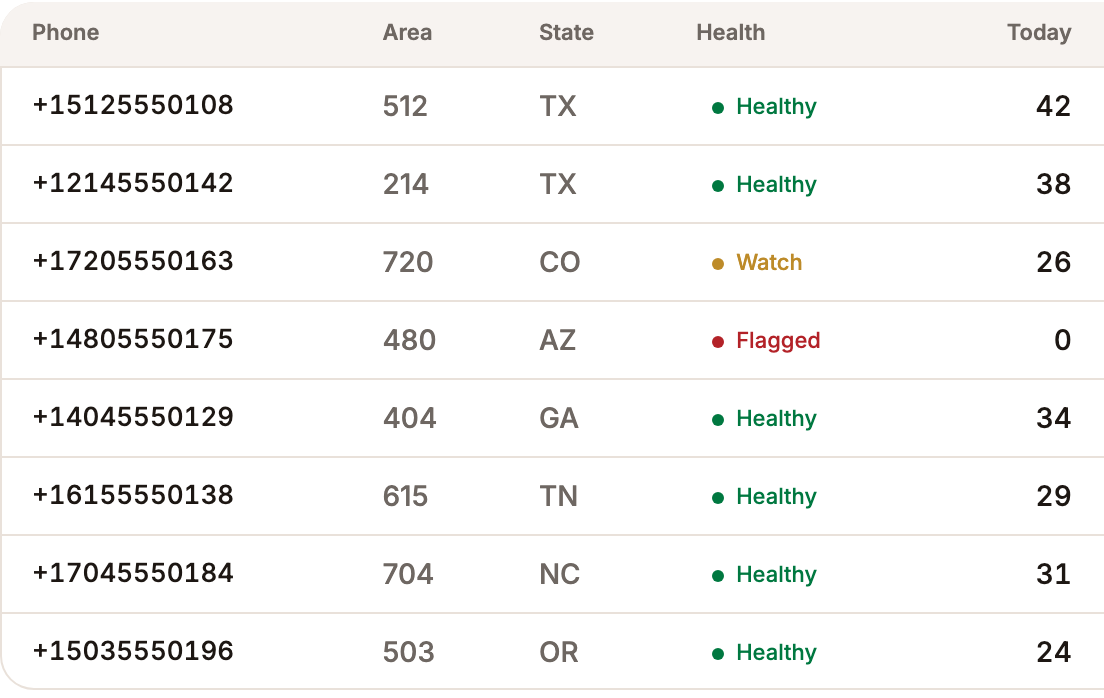
EmberDial can't remove a "Spam Likely" label; carriers and their analytics partners decide. Free Caller Registry lets you register numbers at no cost with Hiya, First Orion and TNS, analytics providers that support the major US wireless carriers (Hiya). See number reputation and the Spam Likely guide.
Callbacks that keep the last conversation
When an agent picks the callback outcome, EmberDial books the date and time in the lead's local time zone, and the callback shows up in "My callbacks today" on the dialer. When it is due, EmberDial puts the lead back into its campaign so the next free agent dials it. Before the redial, the last call's notes, transcript and summary are in call history (when the call was recorded and transcribed), so "call Thursday after she talks to her son" doesn't depend on memory. Missed calls to your local numbers offer a return call where your setup supports it (callback workflow).
Default re-dial waits are 30 minutes after busy, 4 hours after no answer, 1 day after voicemail and 30 days after "not interested", and owners can change them. "Do not call" and "Wrong number" outcomes add the number to your internal DNC list.
Score lead vendors by calling outcomes
Map a vendor column on CSV import (EmberDial recognizes headers such as vendor, supplier and provider), with optional lead cost and list name. EmberDial scores each vendor from 0 to 100 using your team's calling outcomes with its leads: the score rises with callbacks, appointments, transfers and sale outcomes, and falls with wrong numbers and DNC requests. When you import a vendor's next file, the import screen shows that vendor's score for your team over the last 90 days, and the manager dashboard can flag your weakest vendor.
The score weights a sale outcome most and counts a transfer the same as a booked appointment, so leads that transfer well can score high before any policy is placed. Read it as a calling-activity score, not a sales score, and judge vendors on placed policies too.
Practice final expense objections, then get help live
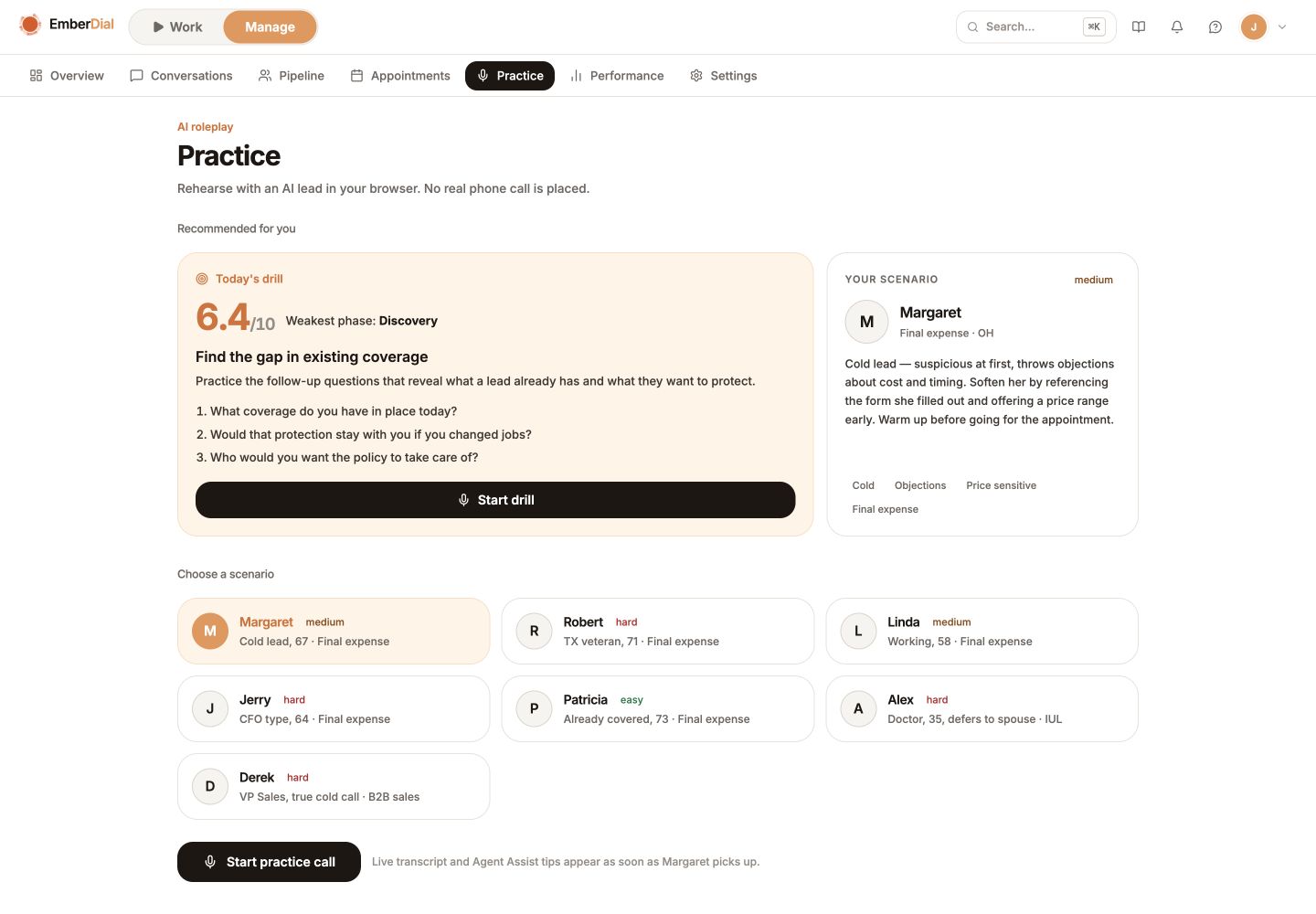
Practice Mode includes a final expense persona, Margaret: 67, a retired schoolteacher on a fixed income who filled in an online form three weeks ago and barely remembers it. She raises "I already have life insurance," "My kids handle that kind of thing" and "How much is this going to cost me?" She warms up when the agent mentions the form and hangs up on pushiness, long monologues or early requests for sensitive details. The recap scores the call and lists objections handled or missed. Practice Mode is offered separately; ask about pricing in your demo.
Agent Assist & coaching (optional, $49 per enabled license per month) follows the live call and suggests what to say next, using a final expense call flow and, if you upload one, your own playbook. On final expense calls it tracks the stage (needs, budget, health questions, application) and flags objections such as price, "I need to talk to my spouse," "I already have coverage" and "How did you get my information?" It never speaks on the call. Each enabled license includes 3,000 assisted minutes a month, pooled across enabled licenses and without rollover, and extra 1,000-minute packs cost $15. Managers can also listen in on live calls from the browser.
Compliance tooling for final expense telesales
| Rule area | What the rule says | What EmberDial does | What stays with you |
|---|---|---|---|
| Calling hours | No solicitations before 8 a.m. or after 9 p.m. at the called person's location (47 CFR 64.1200(c)(1)) | Enforces each campaign's window in the lead's local time (new campaigns default to 8 a.m. to 9 p.m., Monday to Saturday, unless your agency sets other defaults), blocks federal holidays by default, and applies built-in windows for leads whose state is Texas, Alabama or Louisiana | A window that fits every state you call |
| Florida, Oklahoma, Maryland | No calls after 8 p.m. and no more than 3 calls in 24 hours on the same subject (Fla. Stat. 501.616(6); 15 O.S. 775C.4; Md. Com. Law 14-4503) | For leads whose state is FL, OK or MD, caps attempts at 3 per phone number per 24 hours (1 per 8 hours for Maine). Does not enforce the 8 p.m. cutoff. | Ending those campaigns at 8 p.m. local time |
| Do Not Call | No solicitations to numbers on the National DNC Registry; the safe harbor requires registry data no more than 31 days old (47 CFR 64.1200(c)(2)) | Internal DNC list fed by outcomes. With your own DNC.com account connected, screens leads on import (federal, state, litigator, wireless) and re-checks before dialing when the last check is over 30 days old. Before a campaign can start, the owner either enters the agency's registry SAN and EIN or signs an attestation that the agency handles DNC scrubbing itself; with a SAN on file, federal screening needs a connected DNC.com account. | Registry access or a DNC.com subscription, and your DNC policy |
| Abandoned calls | 3% of live-answered calls per campaign over 30 days; two-second rule | Pacing guardrails above | Confirming the message a lead hears when no agent is free; it must name the seller and give a number for do-not-call requests |
| Recording disclosure | Some states require every party's consent to record | Shows a "REC" disclosure reminder in the dialer once a lead whose state is CA, DE, FL, IL, MD, MA, MT, NV, NH, PA or WA connects, and keeps it for the rest of that session. It goes by the lead's state, not the agent's. | Saying the disclosure, checking the state list with counsel, and your policy elsewhere |
| Consent records | Autodialed or prerecorded telemarketing calls to cell phones need prior express written consent (47 CFR 64.1200(a)(2)) | Detects Jornaya LeadiD and TrustedForm columns on import, stores them with the lead, and flags rows without either as unverified | Claiming certificates with the vendor (unclaimed TrustedForm certificates are deleted after about 72 hours unless extended, per ActiveProspect) |
State exemptions for insurance agents. Florida exempts licensed insurance agents from most of its telemarketing act, but expressly not from the hours and three-call limits in 501.616(6) (Fla. Stat. 501.604). Oklahoma's 2022 act, as enacted, exempts licensed insurance agents soliciting within the scope of their license (15 O.S. 775C.5). EmberDial applies its Oklahoma cap regardless, so ask counsel whether the exemption covers your calls.
One-to-one consent. The FCC's 2023 rule limiting written consent to one seller at a time never took effect. The Eleventh Circuit vacated it on January 24, 2025 (Insurance Marketing Coalition v. FCC), and the FCC has since removed it (Womble Bond Dickinson).
More: compliance tooling and our ATDS position.
What a five-license final expense team pays
Assume five agents calling at once (five concurrent licenses), each license averaging 5,000 connected minutes a month, about 3.8 connected hours a day over 22 calling days. Connected minutes are answered call time, including calls answered by voicemail; ringing and practice don't count.
| Line item | Math | Monthly |
|---|---|---|
| Calling licenses | 5 × $99 | $495 |
| Connected minutes | 25,000 × $0.02 | $500 |
| Local numbers | 50 included | $0 |
| Total | $995 ($199 per license; 3.98 cents per connected minute) | |
| Agent Assist & coaching on all five (optional) | 5 × $49 + 10 × $15 packs | +$395, for $1,390 |
Five Agent Assist licenses include 15,000 pooled assisted minutes a month. With guidance on all 25,000 connected minutes in this example, the rest take 10 prepaid 1,000-minute packs at $15 each.
| Connected minutes per license | Without Agent Assist | With Agent Assist on 5 |
|---|---|---|
| 3,000 | $795 | $1,040 |
| 5,000 | $995 | $1,390 |
| 7,000 | $1,195 | $1,740 |
These figures use the rates published on our pricing page. Totals exclude extra numbers ($1 each a month), a CRM connection ($499 one time, included for teams of 10 or more licenses), taxes and separately confirmed surcharges. A warm transfer to an outside number adds a second answered leg that also counts. Licenses cover simultaneous callers, so seven agents on two shifts, five calling at once, need five licenses. Try other numbers in the dialer cost calculator.
Where EmberDial is not the right fit
- Fronter-to-closer floors. EmberDial warm-transfers to a named, idle teammate or to a phone number. There's no closer queue that routes each transfer to the next free closer. Transfer-heavy floors fit better on a dialer with queue-based transfer routing.
- Medicare Advantage and Part D calls. CMS requires third-party marketing organizations to record marketing and sales calls in full, keep them at least six years and use the TPMO disclaimer (42 CFR 422.2274(g)(2); 42 CFR 423.2274(g)(2)). EmberDial has no TPMO disclaimer tooling and keeps recordings 24 months by default.
- CRM sync. Leads arrive by CSV import with field mapping. A connection to your CRM is set up on request during onboarding.
- Voicemail drop. Coming soon, for leads with approved consent evidence.
- Very high-ratio predictive. Predictive tops out at eight lines per agent and starts cautiously, by design.
Frequently asked questions
What is the best dialer mode for final expense leads?
It depends on the lead. Use power at one line per agent for fresh, exclusive web leads and predictive for aged lists with low pickup rates. A scheduled callback returns to its campaign for the next free agent when it is due, so keep line caps low where callbacks matter. EmberDial sets power or predictive per campaign, so you can run both at once.
Does EmberDial have a predictive dialer?
Yes. Campaigns run in predictive or power mode, and agents can also place single calls from the dialpad. Predictive starts at two lines per agent, adds lines only as pickup data supports it, up to the Max ratio or eight lines, and slows as the campaign's 30-day abandon rate nears or passes 3%. The campaign pauses above 4.5% once it has at least 50 answered calls and 10 abandons.
Will local caller ID stop my calls from showing as Spam Likely?
No. Local caller ID matches the lead's area code, state or region from your own numbers, and the pool shows each number's spam-risk status, but carriers and their analytics partners decide labels. You can rest numbers, request reviews, ask for replacement numbers and register numbers free through Free Caller Registry.
Is EmberDial TCPA compliant?
No dialer makes an agency compliant on its own. EmberDial provides tooling such as DNC screening, calling-hour and state attempt-cap checks, abandon-rate pacing, recording-disclosure reminders and an audit log. Your agency remains responsible for consent and how your team calls. This is not legal advice.
How much does a final expense dialer cost with EmberDial?
$99 per concurrent calling license per month plus $0.02 per connected minute. Five licenses at 5,000 connected minutes each cost $995 a month, or $1,390 with Agent Assist & coaching on every license including its extra packs, before taxes and extra numbers.
Can I see which lead vendors are worth buying from?
Partly. EmberDial scores each vendor from 0 to 100 using your team's calling outcomes and shows that score when you import the vendor's next file. The score counts transfers as wins, so check placed policies in your own records.
See it with your own lead mix
Bring your lead types, the column names from one vendor file (not the data) and your current dialer bill to a demo. We'll walk through a campaign per lead type with sample data. Ask about a trial while you're there.
Reviewed October 2026. Product details describe EmberDial as of that date. Regulatory references are general information, not legal advice; confirm current rules with counsel.
Sources
Regulations, statutes and cases
- 47 CFR 64.1200, TCPA rules: abandonment, calling hours, DNC, prior express written consent
- 16 CFR 310.4, Telemarketing Sales Rule: abandoned-call safe harbor and calling times
- 47 CFR 64.1601(e), caller ID for telemarketers
- FTC Advisory Opinion 03-1, August 19, 2003: the TSR and insurance telemarketing
- Florida Statutes 501.616: calling hours, three calls per 24 hours
- Florida Statutes 501.604: exemptions, including licensed insurance agents
- Oklahoma Telephone Solicitation Act of 2022, HB 3168 enrolled (15 O.S. 775C.4 and 775C.5), effective November 1, 2022
- Maryland Stop the Spam Calls Act of 2023, Chapter 413 (Com. Law 14-4503(b)), effective January 1, 2024
- 42 CFR 422.2274: Medicare Advantage agent, broker and TPMO requirements
- 42 CFR 423.2274: Part D agent, broker and TPMO requirements
- Insurance Marketing Coalition Ltd. v. FCC, No. 24-10277 (11th Cir. Jan. 24, 2025)